
Please note: This concert is in the past and has already taken place.

An End-of season Summer Concert by the S.L.S.

Add to my Calendar 06-07-2024 19:45 06-07-2024 21:45 36 An End-of season Summer Concert by the S.L.S. What better way to mark the end of the public exam period and the conclusion of our season than a concert of slightly lighter, melody-filled music? I wonder if our chairman had inside information from contacts in Downing Street as there will be some in the audience, no doubt, who will be pleased to see the end of the election campaign two days ago or otherwise at a loose end and ready for some gentle, varied pleasure now that is over! Included as a main work is one of Mozart’s many missa breves: the Missa Brevis in F major, K192., which was completed in Salzburg in 1774. It is a compact but complete mass setting and is full of joyful musical ideas including the "Do-Re-Fa-Mi” motif in the Credo movement which appears also in the finale of the ‘Jupiter’ Symphony. Appropriately, in the centenary year of the composer’s death, the second main item is Stanford’s Songs of the Fleet. I suspect that, were there a round of the T.V. Quiz show ‘Pointless’ on ‘The Works of C.V.Stanford’, this one might make a good bet! The composer is much more well known for his church settings, but this is more than worth a listen. The poems of Henry Newbolt set in this suite of five songs cover matters to do with ships, sailors and naval engagements but hold deeper meanings about life more generally. This is a tuneful and varied suite of choral songs displaying Stanford’s abilities as a composer and was premiered to great acclaim in 1910 at the Leeds Festival. The last of the songs: ‘Fare Well’ became popular on its own during the more modern warfare of 1914-18 which followed all too soon the suite’s composition. To provide an example of Stanford’s church music, we will also perform his uplifting ‘Te Deum’ from his Service in B flat major composed in 1879. A reviewer, Robert Hugill, wrote: "The service is a major milestone in the development of Anglican church music, representing the harnessing of Brahmsian symphonic technique to the needs of the Anglican liturgy. Other shorter items will add further variety to the musical fare. Beckenham Methodist Church, London DD/MM/YYYY

Details

Beckenham Methodist Church
Bromley Road
Beckenham
London
BR3 5JE
England

Programme

Charles Villiers Stanford – Songs of the Fleet, Op.117
Wolfgang Amadeus Mozart – Missa brevis in F major, K.192/186f
Charles Villiers Stanford – Te Deum in B flat, Op.10

Performers

Nicholas Wibberley – Conductor
Jack Stone – organ / piano

South London Singers

Programme Note

What better way to mark the end of the public exam period and the conclusion of our season than a concert of slightly lighter, melody-filled music? I wonder if our chairman had inside information from contacts in Downing Street as there will be some in the audience, no doubt, who will be pleased to see the end of the election campaign two days ago or otherwise at a loose end and ready for some gentle, varied pleasure now that is over!

Included as a main work is one of Mozart’s many missa breves: the Missa Brevis in F major, K192., which was completed in Salzburg in 1774. It is a compact but complete mass setting and is full of joyful musical ideas including the "Do-Re-Fa-Mi” motif in the Credo movement which appears also in the finale of the ‘Jupiter’ Symphony.

Appropriately, in the centenary year of the composer’s death, the second main item is Stanford’s Songs of the Fleet. I suspect that, were there a round of the T.V. Quiz show ‘Pointless’ on ‘The Works of C.V.Stanford’, this one might make a good bet! The composer is much more well known for his church settings, but this is more than worth a listen. The poems of Henry Newbolt set in this suite of five songs cover matters to do with ships, sailors and naval engagements but hold deeper meanings about life more generally. This is a tuneful and varied suite of choral songs displaying Stanford’s abilities as a composer and was premiered to great acclaim in 1910 at the Leeds Festival. The last of the songs: ‘Fare Well’ became popular on its own during the more modern warfare of 1914-18 which followed all too soon the suite’s composition.

To provide an example of Stanford’s church music, we will also perform his uplifting ‘Te Deum’ from his Service in B flat major composed in 1879. A reviewer, Robert Hugill, wrote: "The service is a major milestone in the development of Anglican church music, representing the harnessing of Brahmsian symphonic technique to the needs of the Anglican liturgy. Other shorter items will add further variety to the musical fare.
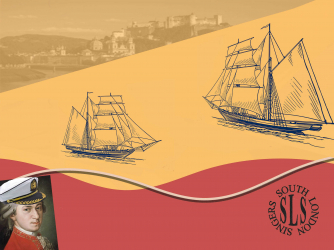
An End-of season Summer Concert by the S.L.S.

Get a route map

Your Map

If you have any questions, please contact us using the form below, or send an e-mail to [email protected].

All form fields are required.

Please check your details and try again.

Thank you for contacting us. We will contact you regarding your enquiry as soon as possible.