 Your events at Classical Events


Details
Blackburn Cathedral
Cathedral Close
Blackburn
Lancashire
BB1 5AA
England
Tickets
Prices: £13 (u19's free)
Book Tickets
Programme
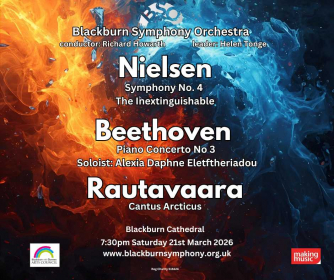
Einojuhani Rautavaara – Cantus Arcticus (Concerto for Birds and Orchestra)
Carl Nielsen – Symphony no.4, Op.29
Ludwig van Beethoven – Piano Concerto no.3 in C minor, Op.37
Performers
Richard Howarth – Conductor
Alexia Daphne Eleftheriadou – piano
Programme Note
Alexia Daphne Eleftheriadou is a Greek pianist based in London. She has appeared as a soloist in venues such as the Glasgow Royal Concert Hall, Queen’s Hall in Edinburgh, and the Greek National Opera recital hall in Athens. In May 2021 she made her debut with the Royal Scottish National Orchestra recording Beethoven’s 3rd Piano Concerto, the concerto she will be playing in Blackburn.
Cantus Arcticus, also known as Concerto for Birds and Orchestra, is a three-part orchestral work by the Finnish composer Einojuhani Rautavarra that incorporates recordings of birdsong.
Cantus Arcticus was premiered 18 October 1972 and has enjoyed wide popularity. The reasons cited include the work's resemblance to familiar tonal music; the way it links music with nature by using recorded birdsong; the novelty of combining such recordings with a live orchestra; and its association with an idealised version of Finland's culture and landscape.
Beethoven's third piano concerto is in C minor and was probably written about 1800. It is the last piano concerto (of 5) to that is influenced by Mozart. But C minor is Beethoven's dramatic key - think of the 5th Symphony - and he does not disappoint here.
The Danish composer Carl Nielsen wrote six symphonies. Nielsen has been described as"one of the most playful, life-affirming, and awkward voices in twentieth-century music" thanks to the "melodic richness and harmonic vitality" of his work. His Symphony No. 4, The Inextinguishable (Op. 29, 1914–16), written during World War I, is among the most frequently performed of the symphonies. In the last movement two sets of timpani are placed on opposite sides of the stage undertaking a kind of musical duel. Nielsen, described the symphony as "the life force, the unquenchable will to live". It is therefore ironic that it was premiered in February 1916 in Copenhagen,during the conflagration of the First World War.