 Your events at Classical Events


Details
City Halls
Candleriggs
Glasgow
G1 1NQ
Scotland
Programme
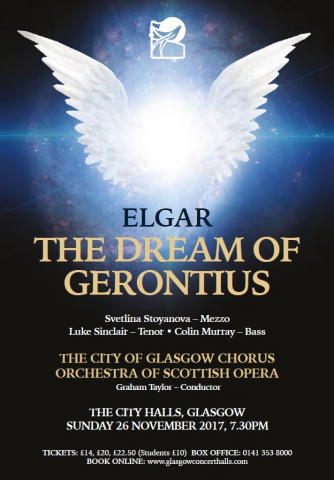
Edward Elgar – The Dream of Gerontius, Op.38
Performers
Svetlina Stoyanova – mezzo soprano
Luke Sinclair – tenor
Colin Murray – bass
Graham Taylor – Conductor
Orchestra of Scottish Opera
City of Glasgow Chorus
Programme Note
ELGAR - THE DREAM OF GERONTIUS
The word “Gerontius” is from the Greek for “old man” and the text is taken from Cardinal John Henry Newman’s poem.
It tells the story of an “everyman” character as he faces death and asks for assistance from the Virgin Mary and other saints. He meets his guardian angel and has sight of God before being taken to Purgatory for purification with the promise of everlasting glory. The work is considered to be Elgar’s finest composition.
The Dream of Gerontius was composed in 1900 for the Birmingham Music Festival of that year and the fact that the finished score arrived less than three months before the scheduled performance proved to be an ill omen.
The work is scored for a large orchestra, including harp and organ, three soloists, double chorus and semi chorus. The lack of rehearsal time for all concerned and in particular with the chorus trying to come to terms with Elgar’s complex writing, proved too much and the first performance was a disaster, not helped by the sudden death of the chorus master whose late replacement, an elderly musician who found himself out of his depth with the complex choral writing. In addition, two of the three soloists were not in the best of voice on the night.
Elgar was deeply upset after this shambolic premiere. However its next performance, in Dusseldorf the following year, was a great success and premieres in London, the United States, Sydney, Vienna and Paris followed in quick succession. Finally Elgar’s composition containing some of his finest writing received appropriate recognition. The contrast of the sadness of Gerontius’ dying moments to the harshness of the Demons’ Chorus to the glorious warmth of the angelic hymn Praise to the Holiest has something for everyone.
The work is now considered one of the greatest choral compositions ever written and was last performed by the City of Glasgow Chorus in 2007.