 Your events at Classical Events


Details
Fareham United Reformed Church
18 Osborn Road South
Fareham
Hampshire
PO16 7DG
England
Programme
Dietrich Buxtehude – Ihr lieben Christen, freut euch nun, BuxWV 51
Dietrich Buxtehude – In dulci jubilo, BuxWV 52
Johann Kuhnau – Ich habe Lust abzuscheiden
Johann Kuhnau – Wie schön leuchtet der Morgenstern
~ Interval ~
Johann Kuhnau – Gott sei mir gnädig
Dietrich Buxtehude – Jesu meine Freude
Johann Sebastian Bach – Der Gerechte kommt um (motet), BWV 1149
Dietrich Buxtehude – Magnificat, BuxWV 203
Performers
Malcolm Keeler – Conductor
Consort of Twelve
Portsmouth Baroque Choir
Programme Note
Portsmouth Baroque Choir is, once again, shining a performative light on niche Baroque repertoire: cantatas by Buxtehude and Kuhnau and an arrangement of Kuhnau by Bach. Performances of their works side by side are infrequent and, indeed, the chances of any of this music surviving down to our age were, in any case, slim but for the efforts of collectors and musicologists.
Nowadays, everything that has survived of Bach's music is available in multiple recordings on numerous streaming platforms or in boxed sets of CDs; his music is performed hourly in some location around the world; Bach is a household name, revered as one of the greatest musicians and composers of all time. For many people, playing or listening to Bach can change the way they see the world helping to retain a hopeful perspective in fractured times. So it is difficult for us to comprehend how, in the winter of 1723, Bach was only the third choice after Telemann and Graupner to succeed Johann Kuhnau, who had died the previous summer, as cantor of St Thomas’s Church in Leipzig. Luckily for Bach, and for us, first choice Telemann had received a better offer from Hamburg and Graupner’s current employer refused to release him. Bach performed two cantatas, BWV 22 and 23 for his “audition”, at a service on 7 February that year, a tough listen for the examiners. While 22 is full of dance rhythms and pays stylistic homage to his predecessor, Kuhnau, 23 is ornate and dense, anticipating the music of the Passions.
Assuming Bach was also asked about his CV, the names Kuhnau and Buxtehude would have figured prominently. Kuhnau is better-known as a composer of pictorial pieces for keyboard. He was the first to write a keyboard sonata and his Clavier-Übung (keyboard practice) influenced Bach. Less well-known are his sacred cantatas, written as annual cycles, as Bach was required to provide. Few have survived, mostly thanks to Bach making a collection of them. We will be performing three: his masterpiece Wie schön leuchtet der Morgenstern for Epiphany, Ich habe Lust abzuscheiden (I desire to die in peace’, based on the Song of Simeon) and Gott, sei mir gnädig (Psalm 51, for Ash Wednesday). All three display a mixture of pietist moderation and operatic flare that would be adopted by Handel as well as by Bach. Kuhnau also practised as a lawyer, he was a prolific theorist, a talented linguist, and even wrote a satirical novel, Der musicalische Quacksalber (1700) on what he considered to be superficial trends in contemporary music, the operas of Telemann presumably a target. You could say that Kuhnau was the last ‘Renaissance man’. More important for Bach is that for decades Kuhnau had directed the St Thomas choir, the Thomanerchor founded in 1212, although it was not in particularly good shape when Bach took over. But that is another story.
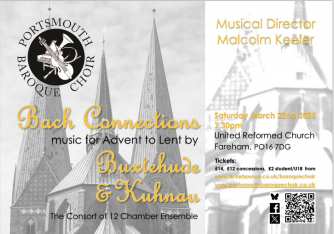
Going back a little further, there was Bach’s famous 260-mile walk from Arnstadt to Lübeck ostensibly to hear the greatest musician of the day, Dietrich Buxtehude, then aged seventy. Bach was given leave to stay one month but he stayed for four, soaking up not only Buxtehude’s organ playing at the Marienkirche (the magnificent roofscape of which dominates our concert poster) but also the weekly concerts (Abendmusik) organised by Buxtehude that included chamber music and dazzling concerted music on a monumental scale involving musicians from several different countries4. Abendmusik became a central cultural event in Lūbeck and was mentioned in travel guides of the time.
Buxtehude’s own music might have disappeared but for the compilation of manuscripts made by Swedish organist Gustaf Düben, including over 100 by Buxtehude. While the memory of Buxtehude lived on as a skilled organist and composer of organ music, mostly written in the first half of his life, his sacred vocal music from the second half was utterly forgotten until the early twentieth century when scholars began rediscovering it. Buxtehude composed his vocal works not to order but entirely on his own initiative, which meant that he was able to achieve a higher standard of quality for that time. The possibility of achieving such a level of professional freedom while carrying out the duties of a church musician established the model for the likes of Handel, Telemann and Bach.
Our concert begins with Buxtehude’s Advent cantata Ihr lieben Christen, freut euch nun and the second half includes Jesu, meine Freude that Bach must surely have heard while in Lūbeck as his later, well-known setting shares striking similarities including key and palindromic form. The concert ends joyfully with a Magnificat setting attributed to Buxtehude. While some scholars believe the score bears all the marks of Buxtehude’s style, others point out that it bears no resemblance to any of his known works and that it looks and sounds more like Lully or Carissimi. But then Buxtehude, like Bach, was a master at imitation.
To reinforce the Bach connection we’ll be singing the funeral motet Der Gerechte kömmt um, attributed to Bach. It is a vernacular re-working (contrafactum) of a Latin motet Tristis est anima mea by Kuhnau. Believed to have been written 1730-5, it bears several hallmarks of Bach’s style: paired wind instruments in the accompaniment, subtle harmonic recolouring and heightened expression. The instrumental introduction foreshadows Mozart and just before the end there is an astonishing moment, very rare for those times, of measured silence.
For this concert of choral rarities we are delighted to have with us members of the Consort of Twelve. Additional instrumental colour and all vocal solos will be drawn from the Choir.