Please note: This concert is in the past and has already taken place.

Bach Magnificat & Handel anthems

Add to my Calendar 19-03-2022 19:30 19-03-2022 21:30 36 Bach Magnificat & Handel anthems In the year that marks the 75th anniversary of the accession of Queen Elizabeth II to the throne, Hereford Choral Society begins its spring concert with The King shall rejoice, one of the four brilliant anthems written by Georg Frideric Handel for the Coronation in 1727 of her predecessor George II. Handel’s music was said to have outshone even the jewellery of Queen Caroline in its magnificence. The King shall rejoice was performed at the precise moment of the coronation. It will be followed by another ceremonial piece by Handel: his setting (in English) of the Latin hymn ‘Te Deum laudamus’ / ‘We praise thee, O God’, written in 1743 to celebrate the victory of a coalition of British, Hanoverian and Austrian troops over the French at the Battle of Dettingen, from which it takes its nickname. George II had commanded his troops on the battlefield, the last British monarch to do so, so the anthem also celebrated his safe homecoming, and is full of military-style flourishes of trumpets and drums. The culmination of our concert is Johann Sebastian Bach’s great setting in Latin of the Magnificat, one of the great texts of Christian worship: the Canticle or Song of Mary, in which she expresses her exultation in telling her cousin Elizabeth that she is to be the mother of the Son of God. The Magnificat would normally have been sung in German, the language of the Lutheran churches where Bach worked, but Latin was used for the great feast days of Christmas, Easter and Whitsun. This spectacular setting was written for the afternoon of the composer’s first Christmas Day as Director of Music at St Thomas’s Church, Leipzig, in 1723. It features five vocal soloists and the largest orchestra that would have been available to Bach for church services at the time, including three trumpets to give real brilliance to the sound. This is one of the most technically demanding pieces Bach wrote for chorus – it is very concise, but truly thrilling either to sing or to hear. Hereford Cathedral, Hereford DD/MM/YYYY

Details

Hereford Cathedral
Cathedral Close
Hereford
Herefordshire
HR1 2NG
England


Programme

George Frideric HandelThe King Shall Rejoice, HWV 260
Johann Sebastian BachMagnificat in D major, BWV 243
George Frideric HandelTe Deum in D major 'Dettingen', HWV 283

Performers

Lauren Lodge-Campbell – soprano
Ellie Neate – soprano
Feargal Mostyn Williams – Alto
David de Winter – tenor
Jack Comerford – Bass
Geraint Bowen – Conductor

Marches Baroque
Hereford Choral Society

Programme Note

In the year that marks the 75th anniversary of the accession of Queen Elizabeth II to the throne, Hereford Choral Society begins its spring concert with The King shall rejoice, one of the four brilliant anthems written by Georg Frideric Handel for the Coronation in 1727 of her predecessor George II. Handel’s music was said to have outshone even the jewellery of Queen Caroline in its magnificence. The King shall rejoice was performed at the precise moment of the coronation.

It will be followed by another ceremonial piece by Handel: his setting (in English) of the Latin hymn ‘Te Deum laudamus’ / ‘We praise thee, O God’, written in 1743 to celebrate the victory of a coalition of British, Hanoverian and Austrian troops over the French at the Battle of Dettingen, from which it takes its nickname. George II had commanded his troops on the battlefield, the last British monarch to do so, so the anthem also celebrated his safe homecoming, and is full of military-style flourishes of trumpets and drums.

The culmination of our concert is Johann Sebastian Bach’s great setting in Latin of the Magnificat, one of the great texts of Christian worship: the Canticle or Song of Mary, in which she expresses her exultation in telling her cousin Elizabeth that she is to be the mother of the Son of God.

The Magnificat would normally have been sung in German, the language of the Lutheran churches where Bach worked, but Latin was used for the great feast days of Christmas, Easter and Whitsun. This spectacular setting was written for the afternoon of the composer’s first Christmas Day as Director of Music at St Thomas’s Church, Leipzig, in 1723. It features five vocal soloists and the largest orchestra that would have been available to Bach for church services at the time, including three trumpets to give real brilliance to the sound. This is one of the most technically demanding pieces Bach wrote for chorus – it is very concise, but truly thrilling either to sing or to hear.
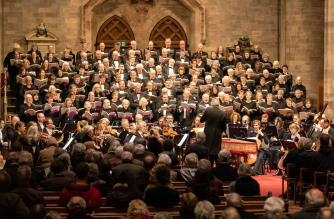
Hereford Choral Society's spring concert in March 2020, a few days before the first Covid lockdown. Credit Michael Whitefoot,dit

Get a route map

Your Map

If you have any questions, please contact us using the form below, or send an e-mail to [email protected].

All form fields are required.

Please check your details and try again.

Thank you for contacting us. We will contact you regarding your enquiry as soon as possible.