 Your events at Classical Events


Details
Portchester Methodist Church
Castle Street
Portchester
Hampshire
PO16 9PS
England
Programme
Johann Sebastian Bach – O Jesu Christ, mein Lebens Licht (motet), BWV 118
Johann Sebastian Bach – Der Geist hilft unsrer Schwachheit auf (motet), BWV 226
Johann Bach – Sey nun wieder zufrieden, meine Seele
Johann Sebastian Bach – Sei Lob und Preis mit Ehren, BWV 231
Johann Christoph Bach – Fürchte dich nicht (motet)
~ Interval ~
Johann Sebastian Bach – Jesu, Meine Freude, BWV 227
Johann Michael Bach – Sei, lieber Tag, willkommen
Johann Sebastian Bach – Ich lasse dich nicht, BWV Anh.159
Johann Sebastian Bach – Lobet den Herrn, alle Heiden (motet), BWV 230
Performers
Malcolm Keeler – Conductor
Peter Gould – chamber organ
Portsmouth Baroque Choir
Programme Note
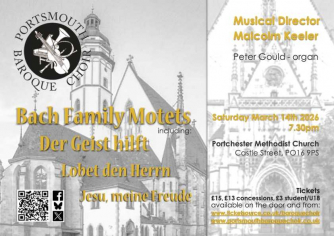
The poster image for Portsmouth Baroque Choir’s concert at Portchester Methodist Church on March 14th shows St Thomas’s Church in Leipzig where, between 1723 and 1727 as the Church’s Director of Music, Johann Sebastian Bach wrote six motets, individual masterpieces crowning a musical form that had a prestigious pedigree reaching back to the Middle Ages and that was well-nurtured by Bach’s extensive musical ancestry as well as by the performance tradition of the St Thomas choir: they have remained central to the choral repertoire ever since. Three of the six will be sung in our programme together with three others re-designated as motets and three motets by Johann Sebastian’s forebears.
Johann Sebastian took pride in his musical ancestry that had stood at the heart of German musical culture and set himself the task, at fifty years of age, to gather every piece of information that he could find about his family’s musical activity as composers, organists, cantors and town musicians. Three of them were composers of some standing: Great Uncle Johann(es) Bach (1604-1673) and 1st cousins, once removed, Johann Christoph Bach (1642-1703) and Johann Michael Bach (1648-1694) who were brothers - Johann Michael was also Johann Sebastian’s first father-in-law. Johann Sebastian had made his own copies of their works and planned performances of them during the services in the various churches in which he served as cantor.
The term motet supposedly derives from the French mot = word and wordiness is one of the main characteristics of this music. However, all four Bachs found a way to set texts that could interpret the sense behind the words in ways that complement and go beyond theological purpose - in the Lutheran liturgy, motets were sung at funeral ceremonies, burials or commemorative services. In this they were supported by the use of pre-existing chorale melodies that gave congregations at the time a handle on what they were hearing. Above all, each of these motets demonstrates deep thinking applied systematically to what would ordinarily be considered musical elaboration or ornamentation and this is what mostly distinguishes the Bach family, Johann Sebastian especially, from their contemporaries.
Chronologically, these motets display development from the standard motet style established by Josquin - all voices singing the same text at the same time - through an increase in elements of the fashionable Venetian style - the choir split into opposing blocks, the use of madrigalisms or word painting and heightened rhythmic interest. Above all, each and every one of these motets contains moments that are extraordinary, such as Johann Michael leaving the soprano line silent for almost forty bars in Fürchte dich nicht before entering by themselves as if coming gently to the rescue; Johann Sebastian creating a musical image of the strength of the Holy Spirit at the start of Der Geist hilft and generally taking contrapuntal complexity to new extremes while deploying the full vocal range in all parts.
Expect to be moved profoundly by this music but do not expect music shaped by twists and turns of fate leading relentlessly to a comic or tragic outcome. There are no cheap self-deceptions here either. The Bach family bequeathed to us music that, in a sense, thinks about itself in order to be genuinely expressive, musical inventions that are like 3-D puzzles, music that is playful and enjoyable that can seize the listener like a favourite dance number, music that is under control, that won’t fail, but is never predictable nor dull, always interesting, still full of surprises after a quarter of a millennium. Also, however cerebral and contrapuntal, it is always sensual and in search of the extraordinary. You sense the human composer behind the music, researching and contemplating God’s order with awe and humility, and in which life and death, past and future can be glimpsed in the excitement of the composer’s momentary inspiration, nudging always at our sense of being alive. British composer Robin Holloway in Music’s Odyssey wrote:
it’s difficult to think of any composer, performer, lover of music, for whom Bach is not the Grand Central meeting-point/exchange-rate/gold-standard/source-and-goal. He represents music itself at its essence: what it is, what it is for.
All of which is to be conveyed by performers who have lived and worked with this music for most of their lives. Be sure, if you’re in the vicinity, not to miss this concert, the like of which has never been performed in this region.