 Your events at Classical Events


Details
Southernhay United Reformed Church
Dix's Field
Exeter
Devon
EX1 1QA
England
Programme
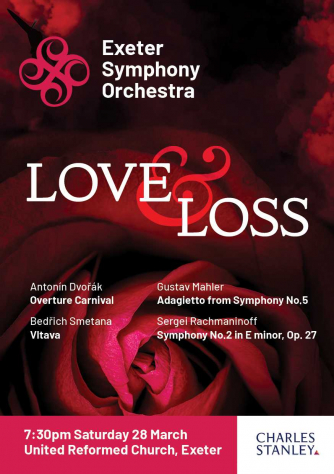
Antonin Dvorak – Carnival Overture, Op.92
Bedřich Smetana – Ma Vlast: Vltava 'The Moldau'
Gustav Mahler – Symphony no.5: Adagietto
Sergei Rachmaninov – Symphony no.2 in E minor, Op.27
Performers
Arturo Serna – Conductor
Exeter Symphony Orchestra
Other concerts in this Series (+)
Programme Note
Our ‘Love & Loss’ theme draws on four evocative works from central European composers. First, the Carnival Overture, Op 92 by Antonín Dvořák (1841-1904), arguably the greatest champion of Slavic music, will open the concert. Written in 1892 on the eve of his emigration to the USA, the music ranges from contemplative to exuberant and was an instant success when premiered by the composer in Prague, then months later, New York. The piece evokes Dvořák’s love of nature with confidence and style.
Remaining with Czechia (the country’s modern title), the meandering Vltava by Bedřich Smetana (1824-1884) is another Bohemian favourite. The second of six tone poems from the Má vlast (My Country) symphonic cycle, the work traces the progress of the nation’s longest river – often also referred to by its German title, die Moldau – from two springs in the southern, wooded uplands, via country and capital, to its confluence with the Elbe. The Vltava’s significance in Czech heritage is never far from its rippling surface.
In complete contrast and central to our ‘Love & Loss’ theme is the Adagietto from Symphony No 5 by Gustav Mahler (1860-1911). The entire symphony, a transformation of tragedy to triumph, only received its premiere in London in 1945, but the beautiful fourth movement, Adagietto – marked sehr langsam – was quickly recognised as a distinct programme item by many, including Henry Wood who conducted it in the 1909 Proms, just 5 years after Mahler wrote it as a declaration of love to his wife Alma. Since 1971, in the wider world, many will have become ‘Mahlerians’ on hearing the rapturous soundtrack to the moving Visconti film, Death in Venice.
Our finale, the Symphony No 2 in E minor Op 27 by Sergei Rachmaninov (1873-1943) was composed in 1908 in Dresden, a favourite city of the Rachmaninovs and an escape from the political turmoil of Russia. After the disastrous premiere of his first symphony twelve years before, his 2nd Symphony’s positive reception banished a deep-seated self-doubt and led, eventually, to his permanent migration to New York in 1918. The opening movement of the symphony begins darkly and establishes a dies irae ‘motto’ which characterises the remaining three movements. Many big themes and rapturous harmonies abound, as you would expect, and the emphatic, vivacious closing sequence of the final movement leaves nothing to be desired!