 Your events at Classical Events


Details
St John the Evangelist Church
Sylvan Road
Upper Norwood
London
SE19 2RX
England
Programme
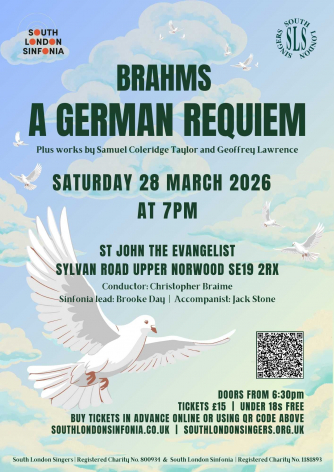
Johannes Brahms – Ein Deutsches Requiem, Op.45
Samuel Coleridge-Taylor – Ballade in A minor, Op.33
Geoffrey Lawrence – Salt Water Songs
Performers
Harrison Gration – baritone
Emma Tring – Soprano
Christopher Braime – Conductor
South London Singers
South London Sinfonia
Programme Note
In this concert, the South London Singers will join with the South London Sinfonia. Happily now both SLS groups are directed by Christopher Braime and we will perform together for our main work: the much-loved German Requiem by Brahms. This was composed with movements added between 1865 and 1868 with the final, seven movement, work (which we will perform in our concert) being given its premiere in February 1869. This is Brahms’ longest composition.
He chose the words himself from the German Lutheran Bible with a focus on consolation, comfort and reassurance for those left behind when someone dies rather than the journey faced by the dead. A humanist rather than a religious approach which surprised some critics. It may have arisen originally due to the death of Brahms’ mother. It has many varied musical highlights in orchestration and in features such as the three fugues. He chose to use a baritone and a soprano soloist but, unlike some requiems, their contributions are beautifully woven in amongst the choral writing rather than in separate movements of their own.
In addition, each ensemble will perform a piece on its own. Appropriately, the SLSingers will reprise Salt Water Songs, written by local composer, the late Geoffrey Lawrence. Geoff was both a member of the SLSingers, for whom he wrote this group of three songs setting the words of ‘Cargoes’ and ‘Trade Winds’ by John Masefield and ‘A Sea Song’ by Allan Cunningham and of the congregation at the venue for this concert: St. John’s.
The SLSinfonia will give us a piece, also appropriately, by another local composer: Samuel Coleridge-Taylor. He lived a large proportion of his short life in Croydon and wrote a large amount of varied music including the Ballade in A minor which we will hear.
Coleridge-Taylor, the son of a British mother and a creole father, was highly admired during his lifetime by many eminent musicians having studied composition under Stanford. In the U.S.A. he was nicknamed ‘the American Mahler’. Elgar recommended him to the Three Choirs festival where this Ballade was premiered. Coleridge-Taylor’s legacy possibly suffered from the immense popularity of his three cantatas based on Longfellow’s epic poem ‘the Song of Hiawatha’. Stanford conducted the premiere of ‘Hiawatha’s Wedding Feast’. This was frequently performed in the inter-war years, championed particularly by Sir Malcolm Sargent using large choirs assembled for the purpose. Its popularity eventually died down, possibly because of the style of the poetry. The music is certainly the sort that singers can throw themselves into enthusiastically. Maybe the focus on these cantatas masked some of Coleridge-Taylor’s other work though several short pieces alongside ‘Hiawatha’ have remained in the repertoire. The anniversaries of his death in 2012 and birth in 2025 have encouraged recordings of a number of other pieces. He wrote in most genres of classical music from a Symphony to an Opera (recently rediscovered) and many pieces of chamber music for different ensembles including this Ballade.