 Your events at Classical Events


Details
St Mary's Church
Park Street
Woburn
Bedfordshire
MK17 9PG
England
Programme
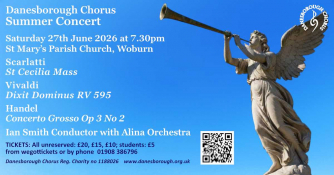
Antonio Vivaldi – Dixit Dominus in D major, RV 595 (11 movements)
George Frideric Handel – Concerto Grosso in B flat major, Op.3 no.2 (HWV 313)
Alessandro Scarlatti – St Cecilia Mass (1720)
Performers
Isabella Hulbert – Soprano
Eleanor Ninham – Soprano
Helena Paish – mezzo-soprano
Joseph Hancock – tenor
Tom Butler – bass
Ian Smith – Conductor
Danesborough Chorus
Alina Orchestra
Programme Note
Alessandro Scarlatti (1660–1725) and Antonio Vivaldi (1678–1741) were two giants of the Italian Baroque period. Their paths never crossed directly, but their musical legacies offer a fascinating study in contrast and complement. Both were prolific, inventive, and deeply influential, yet they approached composition from different angles: Scarlatti was primarily a composer of vocal music, operating at the heart of the Neapolitan operatic tradition, while Vivaldi, though also an opera composer, is best known for revolutionising instrumental music, particularly the concerto.
In 1720, at the age of sixty, Alessandro Scarlatti composed the Mass for Saint Cecilia for the Basilica Santa Cecilia in Rome. Considered to be the crowning achievement of all his church music, this piece provides a stylistic synthesis of the compositional possibilities of the early 18th century, in a score brimming with striking contrasts.
Hailing from Venice, and one of the greatest Baroque composers, Antonio Vivaldi, nicknamed "The Red Priest" because of his red hair, was both a priest and a virtuoso violinist. He composed three settings of Psalm 110, Dixit Dominus. RV 595, is in eleven movements for five soloists, five-part choir and orchestra. This setting is less well-known and more modest than the flamboyant RV 594, though its charms are no less endearing and its choral sonority no less compelling.
Seamlessly stitched together from a masterful patchwork of movements drawn from his earlier operas and cantatas, Handel’s Concerto Grosso Op. 3 No. 2 is notable for its unique five-movement structure and its wonderfully varied orchestration. Its emotional heart is a sublime and deeply tragic Largo of breathtaking beauty, which is framed by movements of brilliant energy and graceful charm, culminating in a magnificent fugal finale. It is a perfect showcase of Handel's theatrical flair and his genius for creating profound art from practical means.