 Your events at Classical Events


Details
St Nicholas Church
Church Green
Harpenden
Herts
AL5 2TP
England
Programme
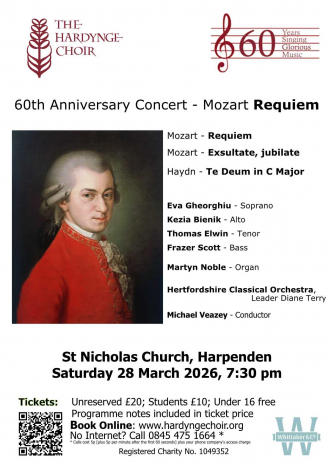
Wolfgang Amadeus Mozart – Requiem in D minor, K.626
Joseph Haydn – Te Deum no.2 in C major 'Grosse', Hob XXIIIc:2
Wolfgang Amadeus Mozart – Exsultate Jubilate, K.165/158a
Performers
Kezia Bienik – alto
Frazer Scott – bass
Martyn Noble – organ
Eva Gheorghiu – Soprano
Michael Veazey – Conductor
Phil Clieve – tenor
Hertfordshire Classical Orchestra
Hardynge Choir
Programme Note
The Requiem in D minor, K. 626, is a Requiem Mass by Wolfgang Amadeus Mozart (1756–1791). Mozart composed part of the Requiem in Vienna in late 1791, but it was unfinished at his death on 5 December the same year. A version, largely completed by Mozart’s student Süssmayr, was delivered to Count Franz von Walsegg, who had commissioned the piece for a requiem service to commemorate the first anniversary of the death of his wife. Walsegg probably intended to pass the Requiem off as his own composition, as he is known to have done with other works. This plan was frustrated by a public benefit performance for Mozart's widow Constanze.
Exsultate, jubilate (Exult, rejoice), K. 165, is a 1773 three-movement motet written by Wolfgang Amadeus Mozart when he was still in his teens. Mozart was staying in Milan during the production of his opera Lucio Silla which was being performed there in the Teatro Regio Ducale. This opera’s leading role was filled by the gifted Italian castrato Venanzio Rauzzini, whose powerful high voice was greatly admired. After hearing Rauzzini’s voice, Mozart wrote Exsultate, Jubilate expressly for him. More recently this motet has been adopted by female sopranos.
Te Deum in C Major (Hob XXIIIc:2), Te Deum for the Empress Marie Therese, is one of Haydn's significant choral works. This piece, dedicated to the Empress Marie Therese, wife of Franz I of Austria, is a rare example of a work from Haydn's late period that doesn't feature soloists. The second of Haydn's Te Deum settings, the work was performed in September 1800 on the name-day of the wife of Haydn's patron, Prince Nicolaus Esterhazy II, and it features the C major tonality and extensive use of trumpets and drums that were often associated with festive ceremony.