 Your events at Classical Events


Details
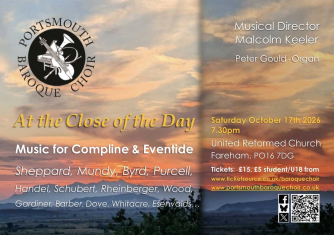
Fareham United Reformed Church
18 Osborn Road South
Fareham
Hampshire
PO16 7DG
England
Tickets
Prices: £15, £5 U18/student
Book Tickets
Programme
John Sheppard – Libera nos I/II
John Sheppard – In Manus Tuas
John Blitheman – In Pace
Robert White – Christe Qui Lux es et Dies IV
William Mundy – O Lord the maker of all thing
Charles Wood – Nunc dimittis in B flat
Peter Philips – Salve Regina
Henry Balfour Gardiner – Evening Hymn
~ Interval ~
Jonathan Dove – Seek Him that maketh the Seven Stars
Charles Wood – Hail, Gladdening Light
Eriks Esenvalds – Stars
Samuel Barber – Sure on this shining night, Op.13 no.3
Josef Gabriel Rheinberger – Abendlied, Op.69 no.3
Franz Schubert – Die Nacht, D.983 no.4
Arthur Sullivan – The Long Day Closes
Eric Whitacre – Sleep
John Wilbye – Draw on, Sweet Night
Performers
Malcolm Keeler – Conductor
Peter Gould – organ
Programme Note
As evening falls and you take stock of the day, what is your remedy for winding down and for warding off the shapeshifting terrors of our times? Which way do you turn for reassurance? With exquisite timing, Portsmouth Baroque Choir presents a programme of musical musings from three eras, all focused on that liminal moment as the glare of the sun gives way to the glimmer of distant stars.
The programme is framed by two timeless Renaissance masterpieces: Sheppard’s Libera nos, about which a prominent musician recently posted on X “when it comes on shuffle you just weep for the beauty that is in the world, and for those that would attempt to destroy it”; and Wilbye’s iconic madrigal Draw on, sweet night - its enfolding musical shapes evoking the black bile of melancholy that also inspires, a theme that pervades the music of Wilbye’s close associate, John Dowland, whose 400th anniversary is celebrated this year.
The Renaissance eventide selection also incudes Byrd, Phillips, White and Blitheman, dutifully crafted treatments of the ‘abide with me’ theme for use at Compline - Withhold from us our ghostly foe,/ That spot of sin we may not know, lines from the nocturnal hymn Te lucis ante terminum that continued to inspire composers down to our own times, two of the most famous examples being Rheinberger’s Abendlied, written when he was just sixteen, and Balfour Gardiner’s Evening Hymn from 1908.
Gardiner’s contemporary, Charles Wood, looped back even further in Hail, gladdening light to an ancient Greek lamp-lighting tradition. This year marks the centenary of Wood’s death and we also include his evening canticle, Nunc Dimittis in B flat, written for and first performed at Westminster Cathedral in 1916.
The intervening Romantics drew inspiration from Nature rather than the Word. Schubert’s Die Nacht sets a whispered, lyric poem extolling the beauty of night’s heavenly calm, while Sullivan in The long day closes goes to a dreamless bed courtesy of Henry Fothergill Chorley’s decorous expression of Victorian-style grief. Barber keeps faith with enduring values in Sure on this shining night.
And so to our own times, concerned with sleep patterns and cosmic disorder. Fashionable Eric Whitacre tackles insomnia, measured breathing overcoming the thousand pictures filling his bedtime head. Inspired by starlight, Jonathan Dove seeks and celebrates, to a twinkling organ accompaniment, the seven stars of Orion a powerful representation of darkness shining as the day, while in Stars (2011), Latvian composer Ēriks Ešenvalds employs tuned wine glasses and Tibetan bells as a glistening accompaniment to his vision of ‘beating hearts of fire’ seen overhead on a still, dark night.
May you have a good evening! At the end of the day, whether you’re a watcher of the night sky, say your bedtime prayers or just switch off, you’ll find the overall mood of this programme inspiring as well as quietly reassuring.
Better that endless notes beseech
as many nights, as many dawns,
If finally God grants the wish.
Eric Larkin Compline