 Your events at Classical Events


Details
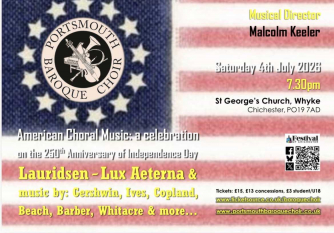
St George's Church
43 Cleveland Road
Whyke
Chichester
West Sussex
PO19 7AD
England
Programme
William Billings – I am the Rose of Sharon
William Billings – Cobham
Edward MacDowell – To a Wild Rose, Op.51 no.1
Amy Beach – Three Choral Responses
Charles Ives – Psalm 67
George Gershwin – Prelude no.2
George Gershwin – An American in Paris: Blues (arr. Michele Mangani)
Randall Thompson – Alleluia, motet (1940)
Aaron Copland – Four motets
Samuel Barber – Sure on this shining night, Op.13 no.3
~ Interval ~
Aaron Copland – Ching-A-Ring-Chaw
Aaron Copland – Old American Songs: 'Long Time Ago'
Carson Cooman – A Cosmic Prayer
Aaron Copland – Old American Songs: 'I bought me a cat'
Morten Lauridsen – Lux Aeterna
Eric Whitacre – Sleep
William Billings – Wake every breath
Performers
Malcolm Keeler – Conductor
Peter Gould – piano / organ
Christopher Clark – clarinet
Portsmouth Baroque Choir
Programme Note
250 years of American choral music can be characterised as: isolated beginnings in year 1; searching for an American voice in year 110, learning from Paris in year 150, establishing a lingua franca from the WW2 era to the present day.
The Declaration of Independence by the thirteen American states on July 4th 1776 marked the political break with Britain. Cultural divergence followed and was well underway by the time Ralph Waldo Emerson’s American Scholar address, sometimes referred to as the “American Declaration of Cultural Independence”, threw down this resonant challenge a half-century later in 1837: Our day of dependence, our long apprenticeship to the learning of other lands, draws to a close. The millions that around us are rushing into life cannot always be fed on the sere remains of foreign harvests. Events, actions arise, that must be sung, that will sing themselves.
America’s first art song, My days have been so wondrous free (1759) by Francis Hopkinson, one of the Declaration’s signatories, conveys a clear message - ‘live as free as a bird’! Meanwhile, a homespun tradition of sacred music had been evolving under the leadership of William Billings whose influential credo was I think it best for every Composer to be his own Carver. Over a century later, Charles Ives would epitomise the “composer as carver”, notably in his treatment of singing as an extension of talking. Psalm 67 (1894) opens and closes in a church-like manner but is interrupted at the words ‘O let the nations be glad and sing for joy’ by music that emulates that very sentiment, producing a sense of unbridled excitement that is heard in many of Ives’s mature works. Contemporary with Ives and equally sure of their own gifts as a composer, Amy Beach’s Choral Responses (1891) are exquisitely voiced giving little hint of the scale and ambition of her later works that are finally impressing today’s audiences.
The next generation of composers was less dismissive of European musical tradition. Gershwin sought guidance from Ravel, Stravinsky and Berg, while Copland and Barber both headed to Paris to study with Nadia Boulanger. Copland’s Four Motets (1921) are student pieces from that time that are stylistically closer to Fauré than to anything homespun, whereas his Old American Songs, from his fiftieth year, are full of fun and characteristics you’d expect from a culture that produced Oklahoma!
American composers are inspired by their people’s talent for invention and enterprise: the landscape inspires awesome textures, sounds of ineffable beauty, looking to Pacific as well as to Atlantic horizons and beyond, to the stars, all of which goes hand in hand with a re-emphasis on prayer and worship. A Cosmic Prayer (2002) by the astonishingly prolific Carson Cooman sets words by a physics professor, giving thanks for the miraculous variety of creation. Morten Lauridsen, whose popular Lux Aeterna (1997) illuminates most of the second half of this celebration, was also inspired by the abundance of excellent choirs in the USA, likewise an inspiration for Eric Whitacre’s very popular Sleep (2000). This generation of composers has effectively turned the table: younger British choral composers are more likely to be in thrall to their American counterparts than to anyone else.
Portsmouth Baroque Choir under the direction of Malcolm Keeler will take you through a choral soundscape, revealing in the 250 arc from Billings to Whitacre a choral tradition that has pushed at musical boundaries while simultaneously keeping a firm hold on the spirit of that early settler hymnody, full of striving and wonder.
An early parchment copy of the Declaration is held by the West Sussex Record Office, less than a mile from our concert venue and special viewing events will be held at the Record Office over the summer including one on 4th July America 250: The Sussex Declaration - West Sussex Record Office.